Value Engineering and Financial Technology in Construction: Building Smarter, Faster & More Profitable Projects
Introduction: Why Construction Companies Can’t Ignore Financial Intelligence Anymore
Construction projects today are becoming more complex, expensive, and time-sensitive. Because of this, companies can no longer depend on traditional planning methods. Instead, they need smarter strategies that reduce risks while improving financial performance.
This is where Value Engineering and Financial Technology in Construction play a powerful role. When combined with BIM, CAD outsourcing, and Virtual Design & Construction (VDC), these solutions help engineering teams make better decisions before construction even begins.
At Enclave Technology Services, we help developers, EPC firms, consultants, and contractors adopt digital engineering solutions that improve cost efficiency, enhance collaboration, and deliver predictable project outcomes.
H2: What is Value Engineering in Construction?
Value engineering is a structured process used to improve project performance while reducing unnecessary costs. Instead of cutting quality, it focuses on smarter design, material optimization, and workflow efficiency.
For example, engineering teams can compare multiple design alternatives digitally. As a result, they identify the most cost-effective solution without compromising safety or durability.
H3: Key Benefits of Value Engineering
- Optimized design performance
- Reduced project lifecycle cost
- Improved ROI for stakeholders
- Early risk identification
- Enhanced construction efficiency
Moreover, when combined with BIM and 5D cost modeling, value engineering becomes data-driven rather than guess-based.
H2: The Role of Financial Technology in Modern Construction
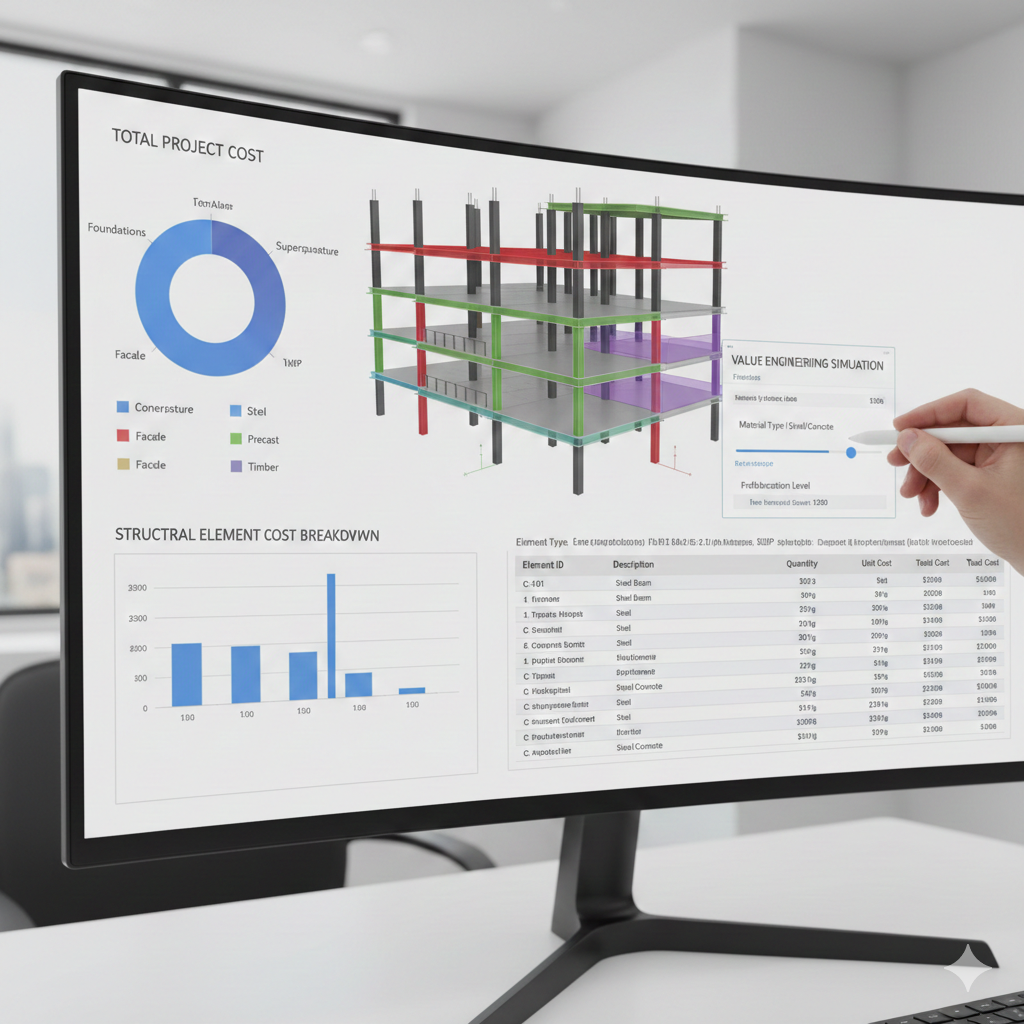
Financial Technology (FinTech) is transforming how construction companies manage budgets, forecasting, and financial risk. Through digital dashboards, cost simulations, and predictive analytics, decision-makers gain real-time insights into project health.
Because financial planning is now integrated with engineering design, teams can forecast budget impacts instantly whenever a design change occurs.
H3: Key FinTech Applications in Construction
- Real-time cost tracking
- Automated financial forecasting
- Digital project budgeting
- ROI simulations
- Risk-based investment planning
Therefore, companies gain better financial control and improved transparency across projects.
H2: How BIM and VDC Enable Value Engineering + FinTech
BIM and VDC technologies bridge the gap between design and financial planning. Instead of relying on separate spreadsheets and drawings, teams work from a centralized digital model.
H3: Key Digital Engineering Advantages
- 5D BIM Cost Simulation
- Clash Detection & Risk Reduction
- Digital Twin Planning
- Construction Sequencing Visualization
- Material Optimization Analysis
Consequently, engineering decisions become more accurate, faster, and financially aligned.
H2: Industry Challenges Without Digital Value Engineering
Many construction companies still rely on traditional workflows. However, these outdated methods often lead to serious challenges.
- Budget overruns
- Project delays
- Design conflicts
- Poor communication
- Financial forecasting errors
On the other hand, companies using digital engineering solutions achieve higher project predictability and smoother execution.
H2: Why Choose Enclave Technology Services?
Enclave Technology Services specializes in engineering outsourcing and digital construction solutions designed for modern infrastructure demands.
Our Strengths
- Industry-focused BIM & CAD expertise
- Experienced engineering professionals
- Cost-optimized outsourcing models
- Advanced VDC simulation workflows
- Dedicated project collaboration support
Because we combine engineering expertise with financial modeling capabilities, clients receive smarter planning and faster project delivery.
H2: Our Service Areas
Enclave supports multiple engineering sectors worldwide.
Core Services
- BIM Modeling & 5D Cost Estimation
- CAD Drafting & CAD Outsourcing
- Virtual Design & Construction (VDC)
- Tekla & Revit Structural Modeling
- Clash Detection & Risk Simulation
- Prefabrication & Precast Modeling Support
Additionally, we work with EPC firms, consultants, infrastructure developers, and manufacturing industries.
H2: How We Work – Our Proven Process
Step 1: Discovery & Project Assessment
We begin by understanding project goals, budget challenges, and engineering requirements.
Step 2: Digital Engineering Strategy
Next, our experts create BIM workflows, cost simulations, and financial forecasting models.
Step 3: Design Optimization
We analyze multiple design options to identify value engineering opportunities.
Step 4: Simulation & Financial Analysis
Using VDC and FinTech tools, we predict project risks and budget impacts.
Step 5: Execution & Continuous Support
Finally, we deliver models, reports, and ongoing project assistance.
Client Testimonials
⭐ “Enclave’s BIM and cost simulation helped us reduce project overruns by nearly 20%. Their engineering team understands real industry challenges.” — EPC Project Manager
⭐ “We outsourced CAD and financial modeling to Yenclave. The result was faster project delivery and stronger ROI control.” — Infrastructure Consultant
H2: Frequently Asked Questions
Q1: How does Value Engineering reduce project costs?
It identifies unnecessary expenses during the design stage, which prevents costly changes during construction.
Q2: Is FinTech useful for engineering companies?
Yes. It helps track budgets, forecast financial risks, and improve investment decisions.
Q3: Which industries benefit from these services?
EPC firms, infrastructure developers, manufacturing plants, real estate developers, and engineering consultants.
Q4: Does Yenclave provide BIM + Financial modeling together?
Absolutely. Our services integrate engineering design with cost simulation and financial planning.
H2: The Future of Construction is Digital + Financially Smart
Construction companies must now focus on data-driven decisions. Because projects are becoming larger and more complex, integrating engineering and financial planning is no longer optional.
Through Value Engineering, Financial Technology, BIM, and VDC, organizations gain better control over timelines, risks, and budgets. As a result, they deliver projects faster while maximizing profitability.