How Precast Tunnel Technology is Transforming Infrastructure Projects in India (2026 Guide)
India is building at a pace the world hasn’t seen before.
From the sweeping metro corridors of Delhi and Bengaluru to the ambitious highway tunnels slicing through the Western Ghats, India’s infrastructure ambition in 2026 is nothing short of breathtaking. But ambition alone doesn’t build tunnels — the right technology does.
That’s exactly where precast tunnel technology steps in. Gone are the days when tunnel construction meant months of cast-in-place concrete, unpredictable delays, and spiralling costs. Today, precision-manufactured precast tunnel segments — engineered with millimetre-level accuracy — are enabling India to build faster, safer, and smarter than ever before.
At Enclave Technology Service, we sit at the heart of this transformation. Our expert team of engineers and BIM modellers in Palakkad, Kerala, has helped clients across India and the Middle East leverage the full power of precast construction — delivering structurally superior, cost-efficient, and timeline-friendly infrastructure solutions.
Whether you’re a project developer, a structural consultant, or a government agency planning a major tunnel project — this guide is written for you. Let’s explore why precast tunnel technology is not just the future of Indian infrastructure; it’s already the present.
What is Precast Tunnel Technology — and Why Should India Care?
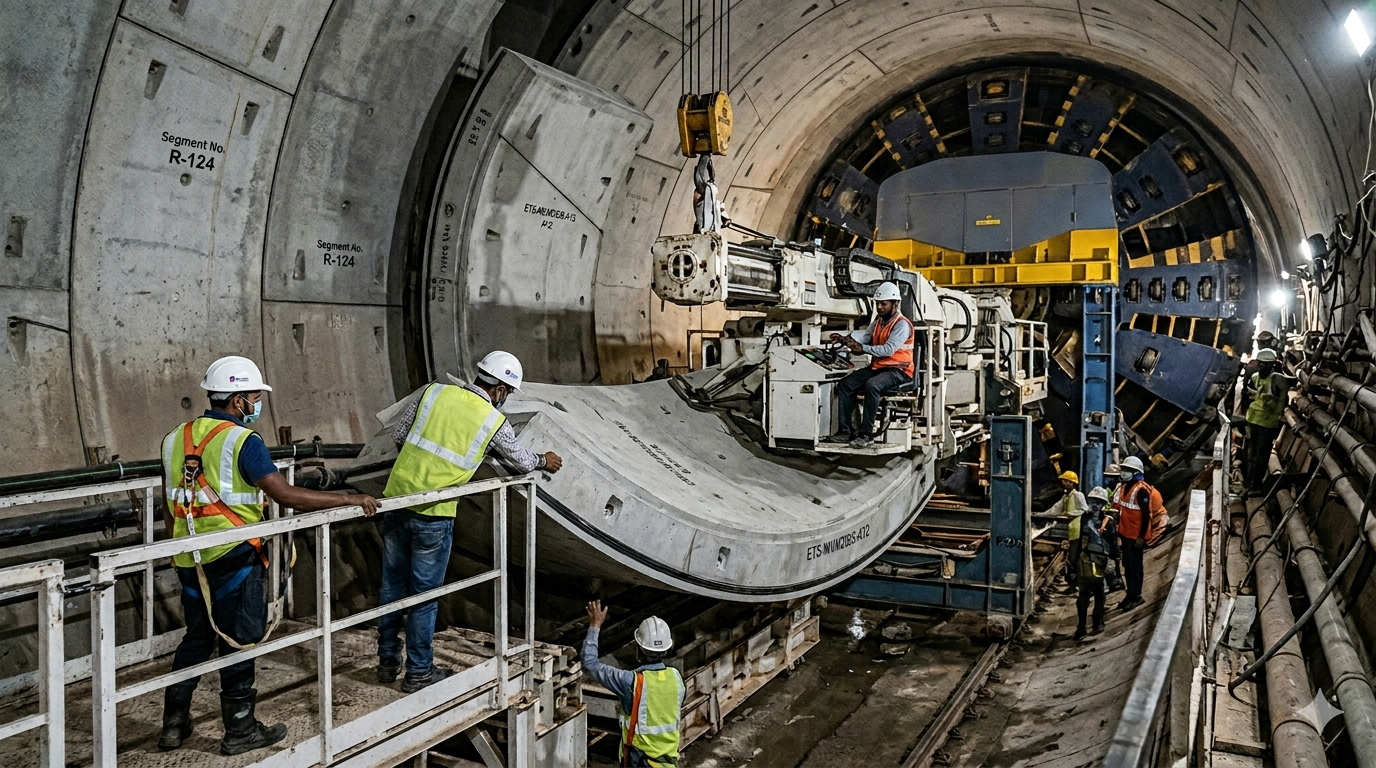
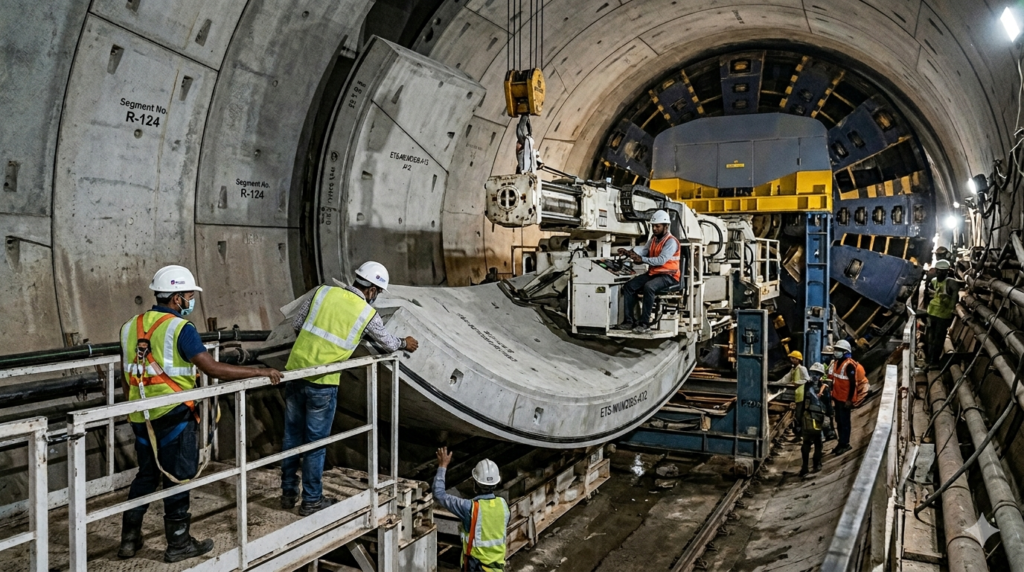
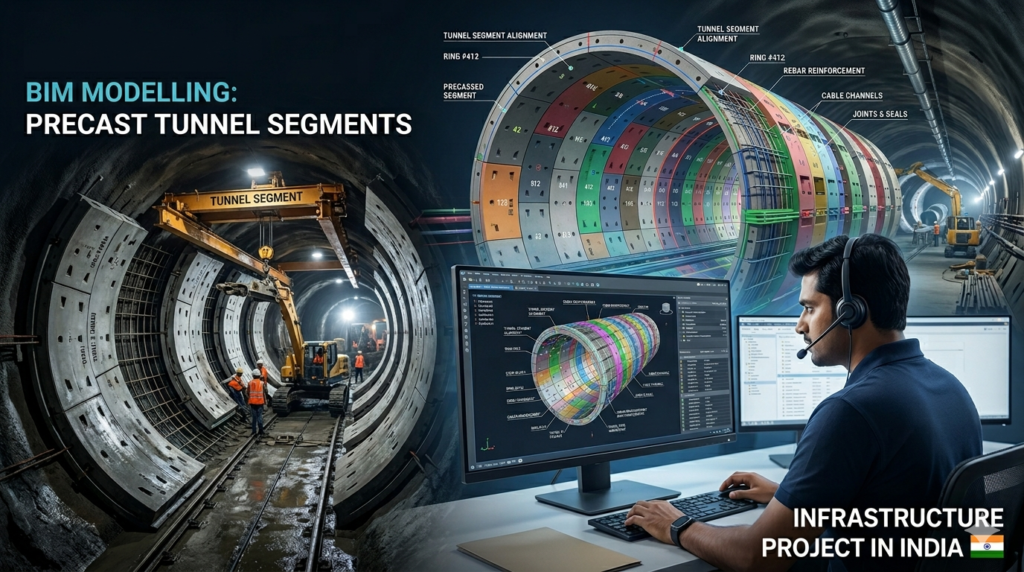
Precast tunnel construction involves the manufacturing of tunnel segments — curved, reinforced concrete units — off-site, in a controlled factory environment. These segments are then transported to the site and assembled to form complete tunnel rings, typically using Tunnel Boring Machines (TBMs) or cut-and-cover methods.
Think of it like building with sophisticated, structural LEGO bricks — except each ‘brick’ weighs several tonnes and has been engineered to exact load-bearing, watertight, and seismic specifications.
For India, the relevance is immense:
- Urbanisation is accelerating — cities like Mumbai, Pune, Hyderabad, and Chennai are expanding underground transit networks.
- Highway projects under Bharatmala and PMGSY demand efficient tunnelling through difficult Himalayan, Deccan, and coastal geology.
- Water supply and sewerage tunnel projects in smart cities require watertight, durable lining solutions at scale.
- Tight project timelines and budget accountability demand technology that performs — not experimental methods.
Precast tunnel technology, backed by robust engineering design and BIM modelling, directly addresses all of these needs.
7 Powerful Benefits of Precast Tunnel Technology for Indian Infrastructure Projects
1. Dramatically Faster Construction Timelines
Speed is money in infrastructure — and precast technology delivers it in abundance. Since tunnel segments are manufactured concurrently while site preparation is underway, total project duration can be reduced by 30–50% compared to conventional cast-in-place methods.
In India’s monsoon-sensitive environment, reducing on-site construction time is not just convenient — it’s critical. Less site exposure means fewer weather-related stoppages, lower risk of waterlogging, and more predictable project handovers.
2. Superior Structural Quality and Consistency
When concrete is cast in a controlled factory setting, quality control reaches an entirely different level. Temperature, humidity, mix ratios, curing cycles — everything is monitored and optimised. The result? Precast tunnel segments that are stronger, more durable, and more consistent than anything you can achieve on-site.
This is especially important for India’s seismic zones (Zones III–V across the north and northeast) where structural performance under dynamic loads is non-negotiable. Enclave Technology Service’s engineering team ensures every precast design accounts for seismic, hydrostatic, and overburden loads — validated through ETABS modelling and structural analysis.
3. Significant Cost Savings Over the Project Lifecycle
While the upfront investment in precast manufacturing infrastructure may seem higher, the lifecycle cost advantage is overwhelming. Here’s why:
- Reduced labour requirement on-site (lower manpower costs)
- Minimal material wastage — factory production is precision-controlled
- Fewer on-site delays = lower preliminary and general costs
- Lower maintenance costs due to superior durability and watertightness
- Reduced contingency budgets — precast performance is predictable
Our Mathcad Calculation services help clients model and validate cost scenarios before a single segment goes into production, ensuring you know exactly where your budget is going.
4. Enhanced Worker Safety
Tunnel construction has historically been one of the most hazardous construction activities. Precast technology fundamentally changes the safety equation. By shifting the majority of manufacturing activity to a controlled factory environment, workers are no longer exposed to the confined, high-risk conditions of underground concrete work.
In India, where construction safety compliance is increasingly scrutinised by the National Building Code and project insurance frameworks, this benefit translates directly into lower insurance premiums, fewer accidents, and a stronger safety record for contractors and developers.
5. Exceptional Watertightness and Durability
Waterproofing is one of the biggest challenges in underground infrastructure across India — whether you’re building under a river in Kolkata, below a water table in Chennai, or through the wet laterite soils of Kerala. Precast tunnel segments incorporate precision-engineered gasket systems (EPDM and hydrophilic seals) that deliver consistently superior watertightness compared to in-situ concrete joints.
With a design life typically exceeding 100 years when properly designed and installed, precast tunnels represent a generational investment in India’s infrastructure backbone. Our SAFE modelling and foundation design services ensure that the structural interface between tunnel lining and subgrade is as robust as the segments themselves.
6. Seamless BIM Integration for Better Project Outcomes
Modern precast tunnel projects don’t just benefit from good engineering — they thrive with intelligent digital delivery. Building Information Modelling (BIM) transforms the way precast tunnel projects are planned, coordinated, and executed.
At Enclave Technology Service, we integrate BIM at every stage of the precast tunnel workflow:
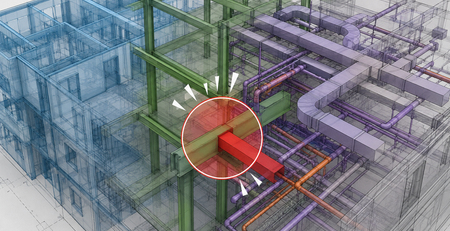
- Autodesk Revit for detailed 3D tunnel lining models, clash detection, and coordinated MEP design
- Tekla Structures for precision steel reinforcement detailing within precast segments — critical for fabrication and quality control
- ETABS for structural load analysis and seismic performance verification
- VDC (Virtual Design and Construction) for 4D construction sequencing and stakeholder coordination
The result? Fewer surprises on-site, better coordination between disciplines, and a digital twin that serves the project from design to handover — and beyond.
7. Environmentally Sustainable Construction
India’s commitment to net-zero carbon by 2070 and the growing green infrastructure agenda under Smart Cities Mission and the National Infrastructure Pipeline demand more sustainable construction practices. Precast construction answers this call directly.
- Factory production generates significantly less material waste than site-cast methods
- Precise material use means lower embodied carbon per unit of structure
- Reduced site activity means lower carbon emissions from heavy construction equipment
- Longer service life means fewer replacements and less lifecycle carbon
Why Choose Enclave Technology Service for Your Precast Tunnel Project?
With so many engineering consultancies in the market, what makes Enclave Technology Service the partner of choice for precast tunnel and infrastructure projects? The answer lies in three things: depth of expertise, breadth of technology, and a genuine passion for engineering excellence.
Our Core Engineering Capabilities
- BIM Modelling: Full 3D digital models for precast tunnel design, including clash detection and quantity take-offs
- Tekla Structures Detailing: Precise rebar detailing for precast concrete segments — ready for direct fabrication
- Structural Analysis (ETABS & SAFE): Load modelling, seismic performance checks, and foundation interaction analysis
- Engineering Calculations (Mathcad): Documented design calculations for regulatory submission and peer review
- VDC & 4D Sequencing: Construction simulation to validate precast installation sequences and optimise TBM progress
- CAD Drafting & Documentation: Comprehensive drawing packages for contractor, client, and regulatory use
Our Service Areas
While headquartered in Palakkad, Kerala, our project portfolio extends across India and into the Gulf and South Asian markets:
- India: Kerala, Tamil Nadu, Maharashtra, Delhi NCR, Telangana, Karnataka
- Middle East: UAE, Saudi Arabia, Oman, Qatar
- Remote & Digital Delivery: We work seamlessly with international teams through cloud-based BIM collaboration platforms
How We Work — Our Process
- Discovery Call: We start with a free 30-minute virtual consultation to understand your project scope, challenges, and goals
- Technical Briefing: Our engineering team reviews your existing data, survey reports, and geotechnical information
- BIM Model Development: We build your project’s digital model — integrating structural, architectural, and MEP data
- Structural Analysis & Validation: Every design is backed by rigorous analysis using ETABS, SAFE, and Mathcad
- Deliverable Package: Final BIM model, CAD drawings, structural calculations, and fabrication details — all delivered on time
- Post-Delivery Support: We stay with you through construction review, RFI responses, and design change management
Real-World Applications: Where Precast Tunnel Technology is Making an Impact in India
Metro Rail Projects
India’s urban metro network is growing rapidly, with projects live or in progress across Bengaluru, Hyderabad, Ahmedabad, Nagpur, Surat, and beyond. Every underground metro section relies on precast tunnel lining systems. TBM-bored tunnels with precast segment rings are the industry standard — and for good reason. They allow metro projects to progress at 15–25 metres per day in favourable ground conditions, with minimal surface disruption to the cities above.
Himalayan Road and Rail Tunnels
The ambitious Char Dham Highway project, Zojila Pass tunnel, and various strategic defence road tunnels in J&K and Northeast India are among the most technically demanding projects in the world. In these challenging Himalayan geologies — where conventional NATM often struggles with squeezing ground, faulted rock, and high overburden — precast lining solutions are increasingly being adopted for secondary and permanent lining applications.
Smart City Water and Sewerage Tunnels
India’s 100 Smart Cities Mission and AMRUT programme are driving major investments in underground water supply and sewerage infrastructure. Micro-tunnelling and pipe-jacking methods using precast concrete pipes and segments are replacing open-cut trenching — reducing surface disruption, faster installation, and dramatically better watertight performance in urban areas.
What Our Clients Say — Real Testimonials
“Enclave Technology Service completely transformed how we approached our precast tunnel lining design. Their Tekla detailing was so precise that our precast manufacturer had zero RFIs during production — a first for us on a tunnel project of this scale. Their team understood the technical nuances of TBM-driven tunnels and delivered exactly what we needed, on time.”
— Pradeep Menon, Senior Structural Engineer, Infrastructure Consultant, Chennai
“We engaged Enclave for BIM modelling on an underground utility tunnel project in Hyderabad. The level of detail in their Revit model saved us significantly in clash resolution during construction — issues we would have caught only on-site had we not had the BIM model. Their team is highly responsive and technically sound.”
— Ananya Krishnaswamy, Project Manager, EPC Contractor, Hyderabad
“From the initial consultation to final drawing delivery, Enclave’s team was professional, knowledgeable, and genuinely invested in our project’s success. Their ETABS analysis for our tunnel portal structure flagged a critical design issue that we were able to correct before construction. That single intervention saved us from a potential structural rework worth lakhs. Highly recommend.”
— Rajiv Sharma, Technical Director, Infrastructure Developer, Delhi NCR
Frequently Asked Questions (FAQs)
Q1. Is precast tunnel technology suitable for all types of tunnel projects in India?
Precast tunnel lining is best suited for soft ground and mixed-face tunnels typically found in metro rail, utility, and water supply applications. For hard rock tunnels in the Himalayas or Western Ghats, it is often used in combination with other methods like NATM for the primary lining, with precast used for permanent lining. Our engineering team will advise you on the most appropriate solution for your specific ground conditions and project requirements.
Q2. How does BIM improve precast tunnel construction?
BIM enables you to build your tunnel digitally before you build it physically. A detailed 3D BIM model reveals clashes between structural, MEP, and civil elements before construction begins. It also supports precise quantity estimation, construction sequencing, and digital handover — delivering measurable cost and time savings across the project lifecycle.
Q3. What software does Enclave Technology Service use for tunnel engineering?
We use Autodesk Revit and Tekla Structures for BIM modelling and rebar detailing, ETABS and SAFE for structural analysis, Mathcad for engineering calculations, and a suite of AutoCAD and VDC tools for drawing production and construction simulation. Our software stack is fully aligned with international project delivery standards.
Q4. Can you work on projects outside Kerala?
Absolutely. We work across India — from Delhi to Chennai, Mumbai to Kolkata — and internationally across the Middle East. Our services are delivered digitally, so geography is no barrier. We use cloud-based BIM collaboration platforms to work seamlessly with clients and project teams wherever they are located.
Q5. How long does a typical precast tunnel BIM modelling project take?
Project timelines vary significantly based on scope and complexity. A focused precast segment detailing package for a metro rail tunnel section typically takes 3–6 weeks. A full BIM model for a complex utility tunnel with integrated MEP may take 8–12 weeks. We always provide a detailed timeline estimate during the initial consultation — with no surprises after engagement.
Q6. What makes Enclave Technology Service different from other engineering consultancies?
Three things: First, we are genuinely multidisciplinary — structural, architectural, MEP, civil, and VDC expertise under one roof. Second, we are technology-native — we don’t use BIM as a buzzword; it’s integral to every project we deliver. Third, we care. Our engineers are personally invested in your project’s success — not just in producing drawings. We have worked with global giants like SNC Lavalin, AECOM, and ACWA Power — and we bring that same international standard to every client, regardless of project size.
The Future of Precast Tunnel Technology in India: What’s Coming Next
- Smart precast segments: Embedded sensors for real-time structural health monitoring of tunnel linings — already being trialled in a few metro projects
- 3D printing of tunnel segments: Research is progressing on using large-format 3D concrete printing for custom-geometry precast segments — potentially revolutionary for non-circular tunnels
- AI-powered BIM clash detection: Machine learning models trained on tunnel project data to proactively flag design issues before they enter the model
- Digital twins for infrastructure assets: The BIM models we create today are becoming operational digital twins — living models that support asset management for 50+ years post-construction
- Green precast concrete: Low-carbon concrete mixes using GGBS, fly ash, and recycled aggregates are being standardised for precast tunnel segment manufacturing in India
Enclave Technology Service is committed to staying at the forefront of these developments — ensuring our clients benefit from the most advanced engineering approaches available anywhere in the world.
READY TO TRANSFORM YOUR NEXT TUNNEL PROJECT?
Book Your FREE 30-Minute Virtual Consultation with Our Expert Engineers https://www.yenclave.com/contact/
Whether you’re at concept stage or ready to issue for tender — our engineering team will help you unlock the full potential of precast tunnel construction technology for your project.
✅ Free Consultation | ✅ No Commitment | ✅ Expert Engineers | ✅ Global Delivery
Visit: www.yenclave.com
Conclusion: The Time to Embrace Precast Tunnel Technology in India is Now
India’s infrastructure decade has arrived. From metro tunnels under bustling cities to highway arteries through challenging mountain terrain, the demand for efficient, durable, and cost-effective tunnelling solutions has never been greater.
Precast tunnel technology — when properly engineered and digitally delivered — is the answer to this demand. It is faster, safer, stronger, and smarter than conventional methods. And with the power of BIM, structural analysis, and precision detailing, it can be delivered with a level of confidence that simply wasn’t possible a decade ago.
At Enclave Technology Service, we don’t just understand this technology — we live it. Our team of passionate engineers and BIM professionals is ready to bring that expertise to your project, wherever you are in India.
Let’s build India’s infrastructure future — together.