How BIM, VDC, and Structural Design Help Build Reliable Infrastructure Projects
Introduction
Infrastructure projects require precision, coordination, and long-term performance. Today, BIM, VDC, and Structural Design have become essential tools for delivering reliable infrastructure projects. From reducing design conflicts and improving collaboration to enhancing construction planning and structural safety, these technologies help project teams achieve better outcomes. As infrastructure projects continue to grow in complexity, organizations are increasingly adopting BIM, VDC, and Structural Design solutions to improve efficiency, reduce risks, and ensure successful project delivery.
At Enclave Technology Services, we help engineering consultants, architects, contractors, fabricators, and project owners navigate these challenges through advanced BIM, VDC, Structural CAD, and engineering support services. By integrating technology with engineering expertise, we help clients reduce risks, improve project efficiency, and build infrastructure that performs reliably for years to come.
Why Reliability Matters in Infrastructure Projects
Every infrastructure project is expected to achieve three key objectives:
- Complete the project on schedule
- Stay within budget
- Deliver long-term structural performance
Unfortunately, many projects struggle to achieve all three.
Design inconsistencies, coordination issues between disciplines, inaccurate documentation, and construction clashes often result in delays, budget overruns, and unnecessary rework. These challenges not only affect project profitability but can also impact safety and operational performance.
Reliable infrastructure projects are built on a foundation of accurate information, coordinated planning, and intelligent engineering decisions.
This is exactly what BIM, VDC, and Structural Design help deliver.
Understanding BIM: The Digital Backbone of Modern Construction
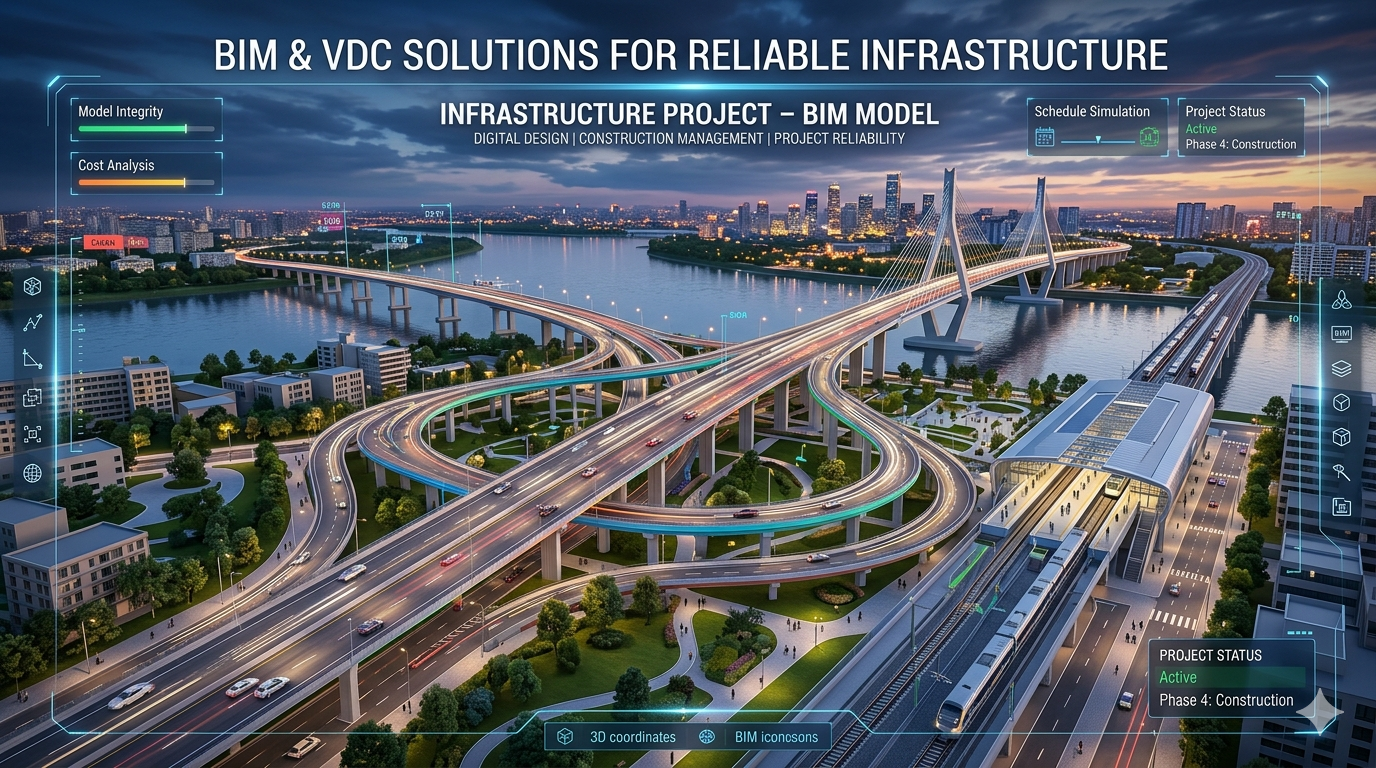
Building Information Modeling (BIM) has transformed the way infrastructure projects are planned, designed, and executed.
BIM is far more than a 3D model. It is an intelligent process that creates a centralized digital representation of a project, allowing stakeholders to access accurate information throughout every stage of development.
Instead of working from disconnected drawings and documents, teams collaborate within a shared environment where project data remains consistent and up to date.
How BIM Improves Infrastructure Project Reliability
Enhanced Design Accuracy
BIM enables engineers and designers to develop highly detailed models that identify issues early in the design stage, reducing costly errors later in construction.
Better Collaboration Across Teams
Architectural, structural, and MEP teams can work from a coordinated model, improving communication and reducing misunderstandings.
Improved Project Visualization
Stakeholders gain a clear understanding of the project before construction begins, allowing faster approvals and better decision-making.
Reduced Rework
Clash detection capabilities help identify conflicts between systems before they reach the job site, minimizing disruptions during construction.
Accurate Quantity Take-Offs
Detailed models provide precise material quantities, supporting more accurate budgeting and procurement planning.
For infrastructure projects involving multiple disciplines and large-scale coordination, BIM provides the transparency and control needed to achieve successful outcomes.
The Role of VDC in Delivering Reliable Infrastructure Projects
While BIM focuses on creating accurate digital models, Virtual Design and Construction (VDC) focuses on how those models are used to improve project execution.
VDC integrates design, scheduling, construction planning, and project coordination into a single collaborative workflow.
The result is a more predictable construction process with fewer surprises.
Key Benefits of VDC
Improved Construction Planning
Project teams can simulate construction activities before work begins, helping identify potential challenges and optimize sequencing.
Better Stakeholder Coordination
Everyone involved in the project has access to the same information, reducing communication gaps and improving accountability.
Risk Mitigation
Potential issues can be identified and addressed during planning rather than during construction, saving both time and money.
Increased Project Efficiency
With better coordination and visibility, teams spend less time resolving conflicts and more time focusing on project delivery.
At Enclave Technology Services, our VDC solutions help clients gain greater control over project outcomes while reducing uncertainty throughout the construction process.
Why Structural Design Remains the Foundation of Every Successful Project
No matter how advanced technology becomes, every infrastructure project ultimately depends on sound structural engineering.
Structural design ensures that buildings and infrastructure systems can safely withstand environmental conditions, operational loads, and long-term usage requirements.
A well-designed structure not only enhances safety but also improves sustainability, durability, and cost efficiency.
How Structural Design Supports Reliable Infrastructure
Safety and Compliance
Proper structural engineering ensures compliance with local building codes and industry standards.
Long-Term Performance
Reliable structures require fewer repairs and maintenance interventions throughout their lifecycle.
Material Optimization
Efficient structural systems help reduce material waste while maintaining performance and safety requirements.
Sustainable Construction
Modern structural engineering practices support environmentally responsible infrastructure development.
Combining structural expertise with BIM and VDC creates a powerful framework for delivering high-quality projects with greater confidence.
How BIM, VDC, and Structural Design Work Together
The greatest project benefits occur when BIM, VDC, and Structural Design are integrated into a unified workflow.
Together, these technologies help teams:
- Improve design accuracy
- Enhance interdisciplinary coordination
- Detect clashes before construction
- Optimize construction sequencing
- Reduce project risks
- Improve communication
- Increase project efficiency
- Deliver higher-quality infrastructure
This integrated approach creates a smoother project journey from concept to completion.
Why Choose Enclave Technology Services
Choosing the right engineering partner can significantly influence project success.
At Enclave Technology Services, we combine engineering expertise with advanced digital technologies to help clients deliver better infrastructure projects.
Experienced Technical Team
Our professionals bring extensive experience in BIM modeling, VDC coordination, structural detailing, and engineering documentation.
Quality-Driven Processes
Every deliverable undergoes thorough quality checks to ensure accuracy and consistency.
Client-Centric Collaboration
We work as an extension of your project team, providing responsive support and clear communication throughout the project lifecycle.
Technology-Focused Solutions
We leverage industry-leading tools and workflows to improve project coordination, visualization, and execution.
Scalable Project Support
Whether you need support for a single project or ongoing engineering services, our team adapts to your requirements.
Our Service Areas
Enclave Technology Services supports clients across diverse industries including:
https://www.yenclave.com/services/
- Commercial Buildings
- Healthcare Facilities
- Educational Institutions
- Industrial Facilities
- Residential Developments
- Transportation Infrastructure
- Government Projects
- Mixed-Use Developments
- Manufacturing Facilities
- Data Centers
How We Work
Step 1: Discovery and Consultation
We begin by understanding your project goals, challenges, and technical requirements.
Step 2: Planning and Strategy
Our team develops a customized BIM, VDC, and engineering workflow tailored to your project.
Step 3: Model Development and Coordination
We create accurate models, perform clash detection, and coordinate project information across disciplines.
Step 4: Quality Assurance
Every deliverable is reviewed to ensure compliance, accuracy, and project readiness.
Step 5: Project Delivery and Ongoing Support
We provide continuous support to help teams maintain project momentum and achieve successful outcomes.
Client Success Story
A commercial infrastructure client approached Enclave Technology Services with coordination challenges involving structural and MEP systems.
Through BIM coordination and VDC planning, our team identified critical clashes before construction began. The project team was able to resolve conflicts early, reduce rework, improve communication, and maintain project timelines.
The result was a more efficient construction process and greater confidence among all stakeholders involved.
Book a Free Virtual Consultation
Reliable infrastructure projects don’t happen by chance. They are the result of careful planning, coordinated execution, and strong engineering foundations.
If you’re looking to improve project efficiency, reduce risks, and strengthen project outcomes, Enclave Technology Services is here to help.
Contact our team today to schedule a free virtual consultation.https://www.yenclave.com/contact/