How BIM Outsourcing Helps AEC Firms Scale Their Projects Without Expanding In-House Teams
Table of Contents
- Why AEC Firms Struggle to Scale BIM Work
- What Are BIM Outsourcing Services?
- When Does BIM Outsourcing Make Sense?
- Which BIM Tasks Can Be Outsourced?
- How Outsourcing Helps During Project Peaks
- BIM Outsourcing vs Building a Larger In-House Team
- Why Quality Control Still Matters
- How to Choose a BIM Outsourcing Partner
- Why Choose Enclave Technology Services?
- Our BIM Services
- How We Work
- Frequently Asked Questions
- Conclusion
Why AEC Firms Struggle to Scale BIM Work
Winning a new project is good news for an AEC firm.
Until the BIM workload starts piling up.
One project becomes three. More drawings need to be developed. Models need regular updates. Coordination meetings become more frequent. Clash reports need to be reviewed. Deadlines stay exactly where they were.
The problem is not always a lack of people.
Sometimes, the existing team is simply being asked to handle too much work at the same time.
Hiring another BIM professional may solve the problem eventually, but recruitment takes time. The workload, however, may only be heavy for a few months.
This is where BIM outsourcing services can provide a practical middle ground.
Instead of immediately expanding the permanent team, an AEC firm can bring in external BIM support for specific projects, production tasks, or periods of high demand.
The idea isn’t to replace the internal team.
It is to give that team more capacity when it needs it.
What Are BIM Outsourcing Services?
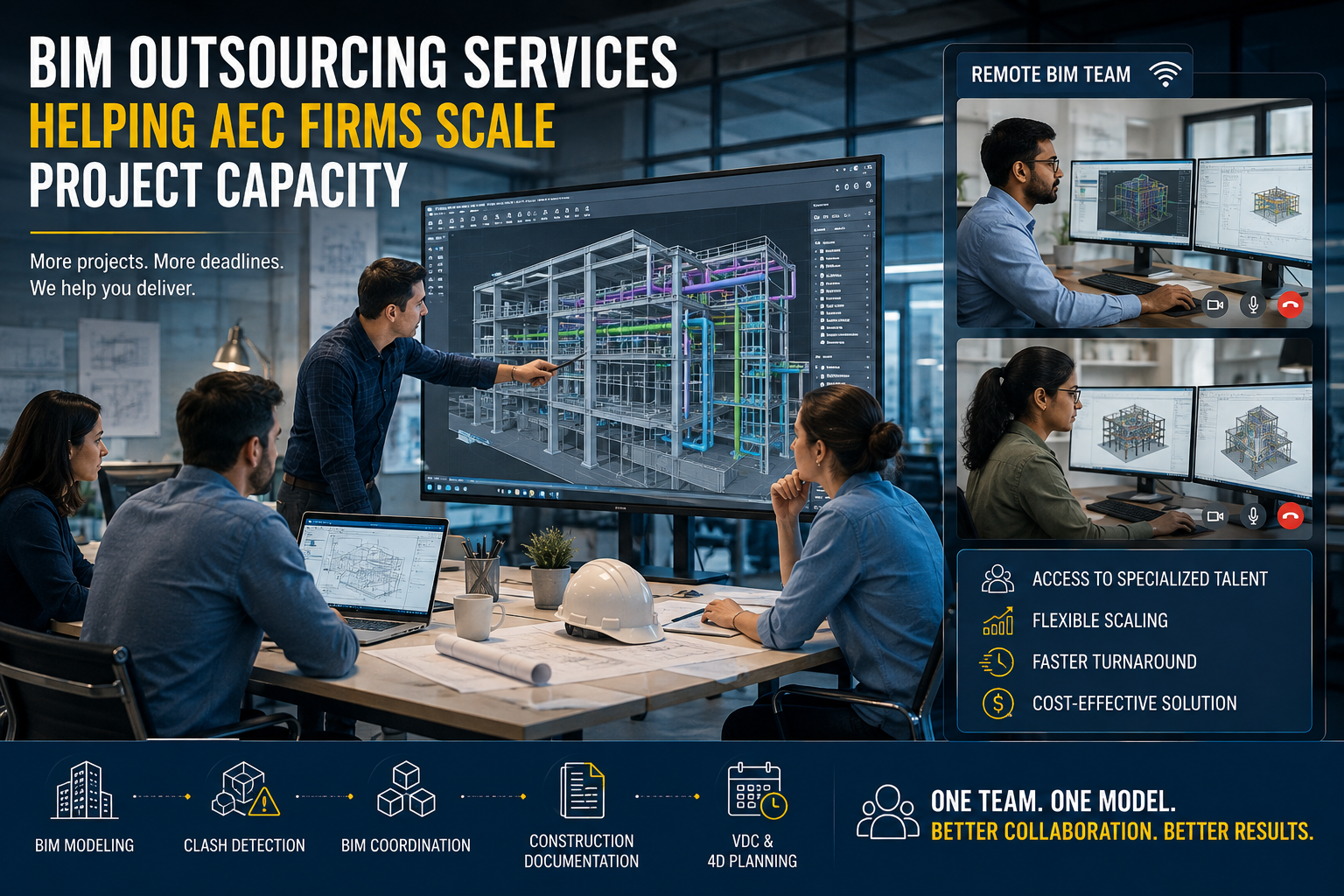
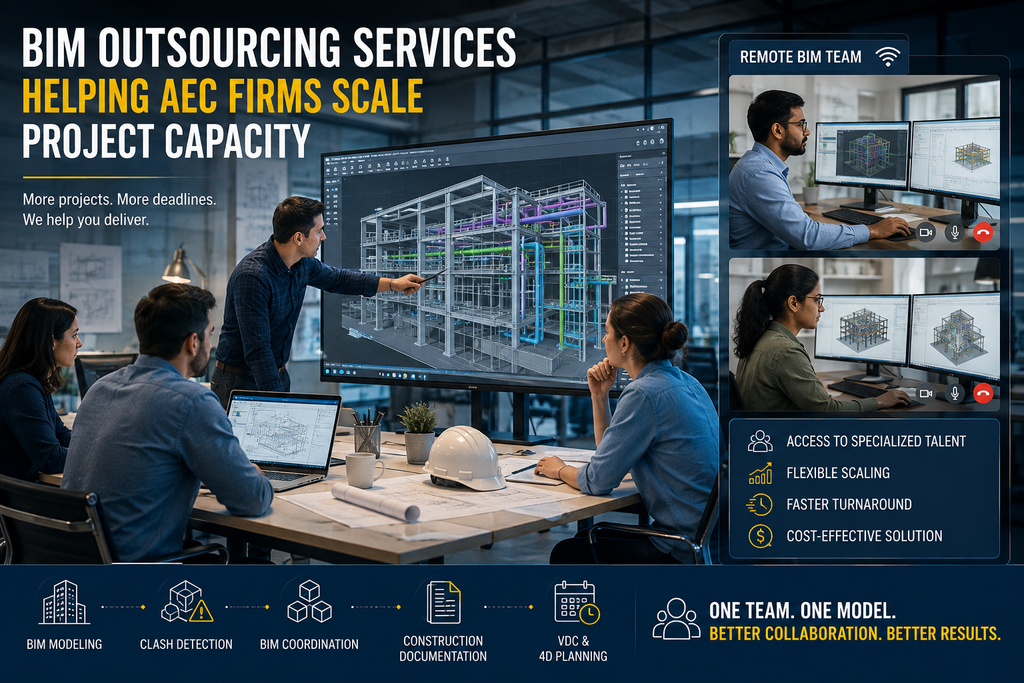
BIM outsourcing services involve working with an external BIM team to handle selected parts of a project’s digital design and documentation workflow.
The scope can be small or extensive.
For example, an AEC firm may outsource Revit modelling for one project while keeping design decisions and client communication in-house.
Another firm may need support with multidisciplinary coordination, clash detection, structural modelling, or construction documentation.
Common outsourced BIM activities include:
- BIM modelling
- Revit modelling
- Structural BIM
- MEP BIM
- BIM coordination
- Clash detection
- CAD to BIM conversion
- Construction documentation
- Quantity information
- VDC support
The right approach depends on the firm’s workload and the type of project.
Recent industry guidance also describes BIM outsourcing as a way to add production capacity for modelling, coordination, documentation, and clash detection without maintaining every capability internally.
When Does BIM Outsourcing Make Sense?
There is no rule that says every AEC firm should outsource BIM.
It becomes useful when the workload starts putting pressure on the existing team.
Your Project Pipeline Has Suddenly Grown
You may have enough projects to keep your team busy, but not enough certainty to justify several permanent hires.
External BIM support can help bridge that gap.
Deadlines Are Getting Tighter
Some project stages create a sudden increase in modelling and coordination work.
If the internal team is already busy, outsourcing selected production tasks can help prevent the entire workflow from slowing down.
You Need a Specialist Skill
Your team may be strong in structural modelling but need additional MEP coordination support for a particular project.
Instead of hiring a permanent specialist for a skill you may only need occasionally, outsourcing can provide access to that capability when required.
Your BIM Team Is Spending Too Much Time on Production
Senior BIM coordinators and engineers should not have to spend all their time on repetitive modelling or documentation updates.
An external production team can take on defined tasks while internal staff focus on coordination, design decisions, client requirements, and project management.
That division can make better use of the skills already available inside the firm.
Which BIM Tasks Can Be Outsourced?
Not every BIM responsibility needs to leave the AEC firm’s hands.
In fact, it often makes more sense to outsource specific production and technical tasks while keeping project strategy and design decisions internal.
BIM Modelling
External teams can develop architectural, structural, or MEP models based on the firm’s drawings, standards, LOD requirements, and project information.
BIM Coordination
Federating models and reviewing how different disciplines interact can be particularly useful when several teams are working on the same project.
Clash Detection
Clash detection can identify conflicts between structural, architectural, mechanical, electrical, and other systems before construction.
CAD to BIM
Older projects often contain 2D CAD drawings rather than coordinated BIM models. Converting this information into a usable BIM environment can be a substantial task.
Construction Documentation
Model updates, sheets, details, schedules, and other documentation can create significant production workloads, especially near project deadlines.
VDC Support
Construction teams may also need digital support for coordination, sequencing, and construction planning.
These services don’t necessarily need to be outsourced as one package. A firm can choose the areas where additional capacity is actually needed.
How Outsourcing Helps During Project Peaks
BIM workloads are rarely perfectly consistent.
A firm might have a relatively manageable schedule one month and then suddenly have several projects entering detailed coordination at the same time.
This is where flexibility becomes valuable.
Suppose an engineering firm has three active projects. Its internal team can manage the normal workload, but all three projects suddenly require detailed BIM updates and clash coordination.
Hiring several full-time employees may not make sense if the workload will return to normal after the deadline.
BIM outsourcing services can provide temporary additional capacity without permanently changing the organisation’s structure.
The internal team can remain responsible for project direction and quality, while the external team handles agreed production tasks.
This approach is increasingly discussed as a practical way for AEC firms to manage workload peaks, staffing gaps, and specialist requirements.
BIM Outsourcing vs Building a Larger In-House Team
The choice isn’t always outsourcing or in-house.
For many firms, the better answer is a combination of both.
An internal team can retain responsibility for:
- BIM standards
- Design decisions
- Client communication
- Project strategy
- Quality control
- Final approvals
An external BIM team can then support:
- Model production
- Documentation
- Clash detection
- Model updates
- Detailing
- Additional project capacity
This hybrid approach gives the firm control over important decisions while allowing it to increase production capacity when required.
For firms with a consistent, year-round BIM workload, a strong internal team may make sense.
For firms dealing with fluctuating project volumes or specialist requirements, outsourcing can offer more flexibility.
The right model depends on the business, not a universal formula.
Why Quality Control Still Matters
Outsourcing BIM work does not mean handing over a model and hoping everything comes back correctly.
That approach can create more problems than it solves.
A good outsourcing workflow needs clear project standards from the beginning.
Before work starts, both teams should understand:
- Required LOD
- Project standards
- Naming conventions
- File structure
- Deliverables
- Software versions
- Coordination requirements
- Review process
- Project deadlines
Regular reviews are equally important.
An external team should be treated as part of the project workflow rather than as someone working in isolation.
That is especially important for BIM because a technically detailed model can still be difficult to use if it does not follow the project’s standards.
How to Choose a BIM Outsourcing Partner
Choosing a BIM outsourcing company should involve more than comparing prices.
The cheaper option is not necessarily the better option if the model requires extensive corrections later.
Look at the company’s:
Technical Capability
Can the team handle the type of modelling, coordination, detailing, or VDC work your project requires?
Project Experience
Have they worked on projects similar in scale and complexity?
Communication Process
How will markups, revisions, questions, and coordination issues be handled?
Quality Checks
Does the team have a defined QA/QC process before deliverables are submitted?
Scalability
Can they add resources when your workload increases?
Understanding of Your Standards
A BIM partner should be able to work according to your templates, naming systems, LOD requirements, and project workflows.
A good partnership should make your internal team more effective, not create another layer of project management.
Why Choose Enclave Technology Services?
At Enclave Technology Services, we understand that AEC firms don’t always need a larger permanent team.
Sometimes they need the right technical support at the right stage of a project.
We provide BIM, CAD, structural engineering, structural detailing, VDC, clash detection, and construction documentation support for complex projects.
Our approach is to work alongside the existing project team rather than operate separately from it.
That means understanding the required deliverables, project standards, deadlines, and coordination requirements before production begins.
The goal is straightforward:
Add capacity without adding unnecessary complexity.
Our BIM Services
Enclave Technology Services can support AEC teams with:
BIM Modelling
Detailed architectural, structural, and relevant discipline modelling based on project requirements.
BIM Coordination
Coordinating project information across disciplines to identify potential issues.
Clash Detection
Reviewing models for conflicts between systems before they become construction problems.
Structural BIM
Supporting structural modelling and detailing workflows.
CAD Services
Creating and updating accurate technical drawings and documentation.
VDC Services
Supporting digital construction planning and coordination.
Construction Documentation
Helping project teams manage detailed technical deliverables and model-based documentation.
How We Work
We begin by understanding the project scope, existing information, required standards, deliverables, and deadlines.
Once the workflow is clear, the appropriate BIM or engineering resources are assigned.
During production, communication and reviews remain part of the process. Models and drawings are checked against the agreed requirements before delivery.
This approach allows external support to fit into the client’s existing workflow rather than forcing the client to completely change the way the project is managed.
Frequently Asked Questions
What are BIM outsourcing services?
BIM outsourcing services involve hiring an external specialist team to handle selected BIM tasks such as modelling, coordination, clash detection, detailing, or documentation.
Why do AEC firms outsource BIM work?
AEC firms may outsource BIM work when project workloads increase, deadlines become tight, internal resources are limited, or specialist BIM skills are required.
Can BIM outsourcing replace an in-house BIM team?
Not necessarily. Many firms use a hybrid approach where internal teams retain project control and external BIM professionals provide additional production capacity.
What BIM services can be outsourced?
Common services include BIM modelling, Revit modelling, structural BIM, MEP coordination, clash detection, CAD to BIM, VDC support, and construction documentation.
Is BIM outsourcing suitable for small AEC firms?
It can be, particularly when a smaller firm has a project that requires more BIM capacity than its regular team can provide.
How can firms maintain quality when outsourcing BIM?
Clear project standards, regular communication, defined deliverables, model reviews, and a structured QA/QC process are important for maintaining consistency.
Need More BIM Capacity Without Building a Bigger Team?
A growing project pipeline shouldn’t automatically mean a growing permanent team.
For AEC firms, BIM outsourcing services can provide additional modelling, coordination, detailing, and documentation capacity when project demands increase.
At Enclave Technology Services, we work alongside AEC teams to provide practical BIM and digital engineering support based on their project requirements.
If your team is handling more BIM work than it can comfortably manage, connect with Enclave Technology Services to discuss the support your next project needs.