Why BIM Coordination Fails Even When Individual Models Are Correct
Table of Contents
- Why Correct Models Can Still Create Problems
- Where BIM Coordination Usually Breaks Down
- When Design Changes Create New Conflicts
- Why Clash Detection Is Only the Start
- When a Model Is Correct but Not Buildable
- How Better BIM Coordination Helps
- Why Choose Enclave Technology Services
- Our Services
- How We Work
- FAQs
- Conclusion
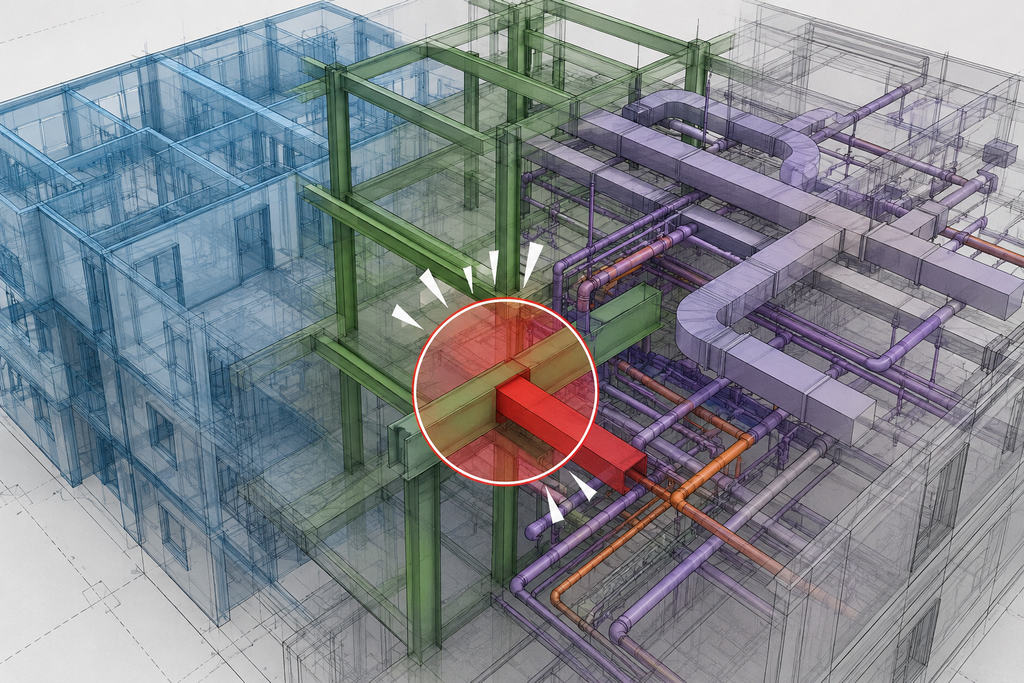
Why Correct Models Can Still Create Problems
Here’s a situation many AEC teams know well.
The architectural model is correct.
The structural model is correct.
The MEP model is correct.
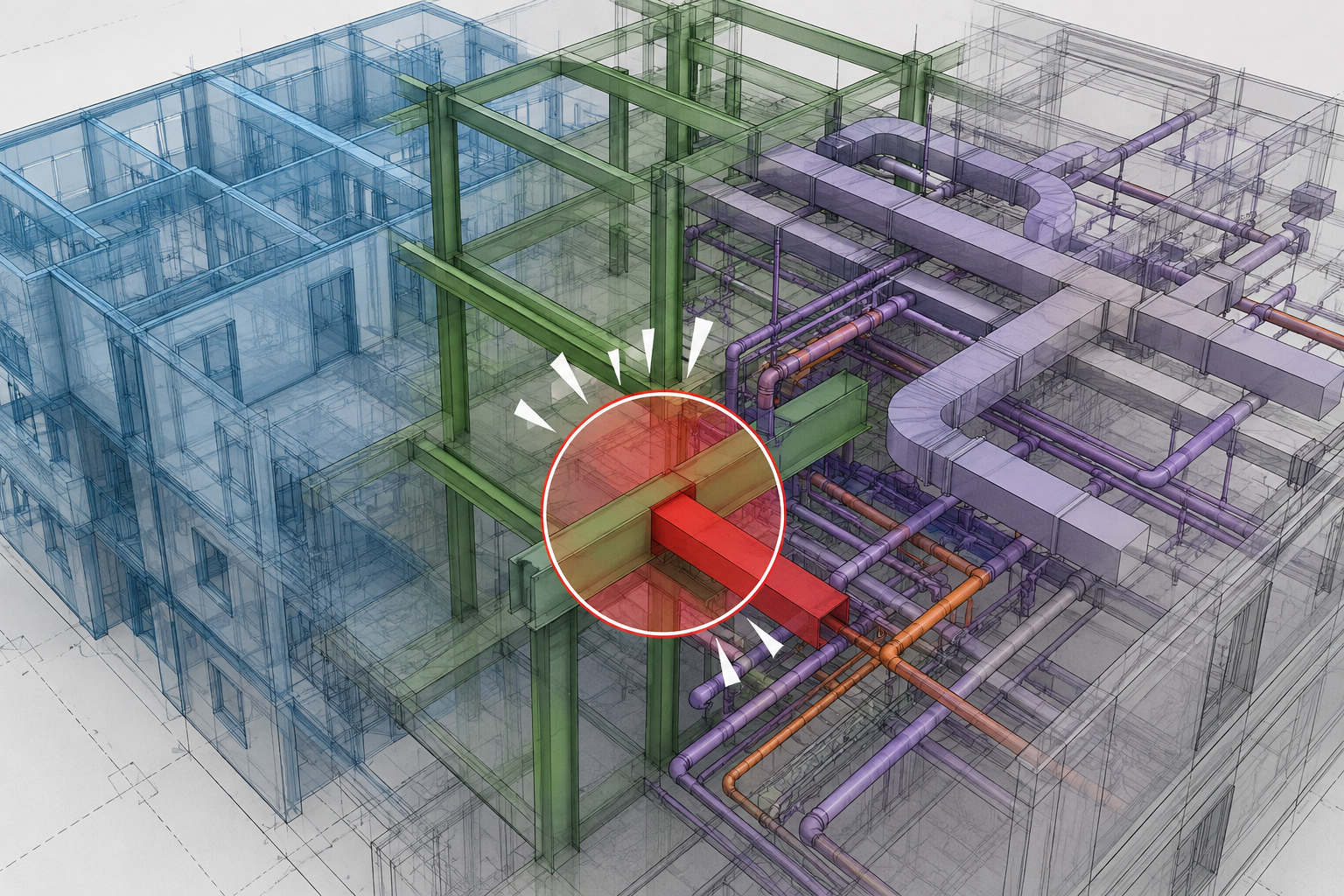
Then the models are combined, and suddenly there is a problem.
A duct runs through a beam. A pipe clashes with equipment. A maintenance route has disappeared.
So, which model is wrong?
Sometimes, none of them.
The real issue is BIM coordination.
Each discipline may have developed its model correctly based on its own requirements. The challenge begins when all those requirements have to work together in the same physical space.
That is why a coordinated project needs more than accurate individual models. It needs a process that continuously checks how those models interact.
Where BIM Coordination Usually Breaks Down
Most coordination problems don’t start with a major mistake.
They often start with small differences.
One team may be working from an older file. Another may have received a revised layout. A third may be using a different set of assumptions.
Individually, the models still look fine.
But when they are federated, those differences become visible.
This is particularly common on large projects where several consultants and subcontractors are contributing information at the same time.
A strong BIM coordination process therefore needs clear rules for:
- Model versions
- Shared coordinates
- Naming conventions
- File exchange
- Revision tracking
- Issue ownership
Good coordination is often less about fixing bad models and more about making sure everyone is working from the same project information.
When Design Changes Create New Conflicts
Design changes are a normal part of construction projects.
The problem is what happens after the change.
Move a piece of equipment, and the surrounding pipework may need to move too.
Change a structural opening, and several services may suddenly need a new route.
Update a room layout, and ceiling coordination may need to be reviewed again.
The original model may have been fully coordinated yesterday.
After a design change, it may no longer be.
This is why BIM coordination is not a one-time activity. Models need to be reviewed again as the project develops.
A simple revision can trigger a chain of changes across different disciplines. Tracking those changes properly is just as important as creating the original model.
Why Clash Detection Is Only the Start
A clash report can contain hundreds of issues.
But not every clash deserves the same attention.
A minor clearance issue is very different from a conflict that prevents equipment installation or affects a structural element.
That is why effective BIM clash detection is followed by proper review.
The team needs to ask:
Is this a real problem?
Who needs to act on it?
What is the most practical solution?
Will the solution create another conflict?
That last question is easy to overlook.
Moving one duct may solve one clash and create another with a cable tray.
So the real process is:
Detect → Review → Resolve → Recheck
The recheck is often where good coordination proves its value.
When a Model Is Correct but Not Buildable
A model can be geometrically accurate and still create problems during construction.
Perhaps the equipment fits, but there isn’t enough room to install or maintain it.
Maybe a service route is technically possible but would be extremely difficult to construct.
Or a structural element is correct, but the proposed sequence makes installation unnecessarily complicated.
This is where constructability becomes important.
BIM coordination should not only ask, “Do these elements clash?”
It should also ask:
“Can this actually be built the way it is shown?”
That shift in thinking makes BIM more useful to contractors and project managers, not just designers.
How Better BIM Coordination Helps
When coordination is handled well, the benefits are practical.
Teams can identify conflicts earlier, communicate more clearly, and reduce the amount of problem-solving that happens under pressure on site.
A coordinated BIM workflow can support:
- Earlier issue identification
- Better multidisciplinary communication
- Reduced rework
- More reliable project documentation
- Better construction planning
It does not mean every project becomes problem-free.
It means the team has a better opportunity to solve problems while they are still digital problems.
That is a much easier place to solve them.
Why Choose Enclave Technology Services?
At Enclave Technology Services, we see BIM as more than model production.
Our work includes BIM modelling, BIM coordination, clash detection, structural detailing, CAD, VDC, and construction documentation.
We support AEC and infrastructure teams that need additional BIM capacity or specialist coordination support.
Our focus is on understanding the project standards, working with the right information, and delivering models and documentation that are useful to the people actually using them.
Because a model doesn’t create value simply because it is detailed.
It creates value when it helps the project make better decisions.
Our Services
BIM Modelling
Developing coordinated architectural, structural, and relevant discipline models.
BIM Coordination
Reviewing models across disciplines and supporting issue resolution.
Clash Detection
Identifying and prioritising potential conflicts before construction.
Structural Detailing
Providing detailed information for fabrication and construction workflows.
CAD Services
Creating and updating accurate technical drawings.
VDC Services
Supporting digital planning and coordination between design and construction.
How We Work
We start by understanding the project scope, standards, available models, deliverables, and deadlines.
From there, we establish the appropriate BIM or engineering workflow.
During development, we coordinate the relevant information, review issues, and maintain communication with the project team.
Before delivery, the work is checked against the agreed requirements.
The objective is simple:
Deliver accurate information that fits into the client’s project workflow.
Frequently Asked Questions
Why do BIM models clash if they are individually correct?
Because each model may satisfy its own discipline requirements while still conflicting with another model when all systems occupy the same space.
What is the difference between BIM modelling and BIM coordination?
Modelling creates the digital representation of project elements. Coordination checks whether those elements work together across disciplines.
Is clash detection the same as coordination?
No. Clash detection identifies potential issues. Coordination involves reviewing, prioritising, resolving, and rechecking those issues.
Can BIM prevent construction rework?
It cannot prevent every issue, but identifying coordination problems during design can reduce the risk of avoidable rework on site.
Why is constructability important in BIM?
A technically correct model still needs to be practical to build, install, access, and maintain. Constructability brings that real-world perspective into coordination.
Need Better BIM Coordination?
When multiple disciplines are involved, accuracy alone isn’t enough.
The models need to work together.
At Enclave Technology Services, we support AEC and infrastructure teams with BIM modelling, coordination, clash detection, structural detailing, CAD, and VDC services.
Get in touch with our team to discuss your BIM and engineering requirements.
Conclusion
BIM coordination rarely fails because every individual model is wrong.
It usually fails because correct information isn’t being coordinated consistently.
Design changes, different assumptions, outdated revisions, and unresolved clashes can quickly turn a clean digital model into a construction problem.
The real purpose of BIM coordination is therefore simple:
Make sure the models don’t just look right individually. Make sure they work together.
For complex AEC projects, that can make a significant difference long before construction begins.