BIM Coordination Services: How AEC Firms Can Keep Complex Projects on Track
Table of Contents
- Why BIM Coordination Becomes Difficult on Complex Projects
- What BIM Coordination Services Actually Cover
- Where AEC Projects Usually Lose Coordination
- How Clash Detection Helps Before Construction
- The Role of Structural BIM and MEP Coordination
- Why BIM Coordination Matters More as Projects Grow
- BIM Outsourcing Services for Growing Project Workloads
- Why Choose Enclave Technology Services
- Our BIM and Digital Engineering Services
- How We Work
- Frequently Asked Questions
- Conclusion
Why BIM Coordination Becomes Difficult on Complex Projects
A project can start with a clean set of drawings and a well-organised BIM plan. Then the project grows.
More consultants come on board.
Design revisions start coming in.
Structural and MEP requirements change.
Equipment layouts move.
Deadlines get tighter.
Suddenly, keeping every model aligned becomes much harder.
This is where BIM coordination services become valuable.
The challenge isn’t always that someone created a bad model. In many cases, every discipline has done its own work correctly. The problem appears when those models have to work together.
A pipe may cross a beam. A service route may leave too little maintenance space. A structural opening may not match the latest MEP requirement.
These are coordination problems, and they are much easier to address before construction starts.
For AEC firms, good BIM coordination is therefore not just about checking a model. It is about keeping project information connected as the design changes.
What BIM Coordination Services Actually Cover
There is a common assumption that BIM coordination simply means running a clash detection report.
In practice, it is much broader.
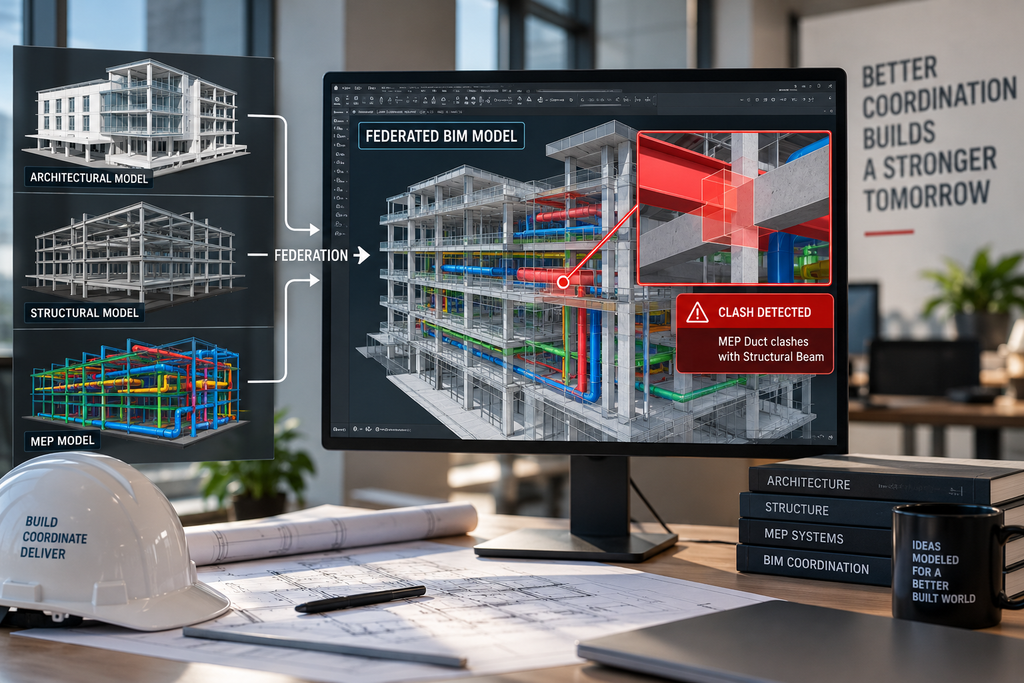
A proper coordination workflow can include model review, federation, clash detection, issue tracking, design coordination, revision management, and coordination between project teams.
Depending on the project, BIM services may involve:
- Architectural model coordination
- Structural BIM coordination
- MEP coordination
- Model federation
- Clash detection
- Drawing and model review
- Issue tracking
- Construction documentation
- Coordination reporting
The exact scope depends on the project and its requirements.
The key point is that coordination should help teams understand how the different parts of the project fit together.
A good model is useful.
A good coordinated model is much more useful.
Where AEC Projects Usually Lose Coordination
Most coordination issues don’t begin with one major failure.
They usually build up gradually.
One consultant updates a model. Another team continues using an earlier revision. An equipment supplier changes a specification. A drawing is updated, but the corresponding model isn’t.
Each change may appear manageable.
Together, they can create a serious coordination problem.
This is especially common on large projects where several organisations are working at the same time.
Without a clear process for exchanging models, managing revisions, and recording issues, teams can spend a surprising amount of time asking basic questions:
Which model is current?
Which revision should we follow?
Has this change been coordinated?
Who is responsible for resolving this issue?
Strong BIM coordination services help bring structure to that process.
How Clash Detection Helps Before Construction
Clash detection is one of the most visible parts of BIM coordination, but it is only useful when the resulting information is acted upon.
A coordination review may identify a duct crossing a structural beam, or a pipe passing through an area occupied by another service.
But finding the clash is only step one.
The project team still needs to decide what should change.
Should the pipe move?
Should the structural element change?
Can another route solve the issue?
Will the proposed solution create a new problem somewhere else?
That is why effective clash detection services are closely linked to coordination and engineering judgement.
The objective is not to produce a large list of clashes.
It is to identify meaningful issues, prioritise them, resolve them, and then check the solution again.
That second check is important.
Fixing one clash can easily create another.
The Role of Structural BIM and MEP Coordination
Some of the most difficult BIM coordination challenges happen where disciplines meet.
Take a structural beam, for example.
The structural team needs it for the building’s load path. Meanwhile, mechanical and electrical services need to pass through the same general zone.
Neither discipline is necessarily wrong.
They simply have different requirements.
This is where structural BIM and MEP coordination become closely connected.
A coordinated model allows teams to review structural elements alongside services and equipment. This helps them discuss conflicts using the actual geometry rather than relying only on separate 2D drawings.
The same principle applies to equipment clearances, maintenance areas, shafts, ceiling spaces, service corridors, and other interfaces.
The earlier these conversations happen, the easier they generally are to manage.
Why BIM Coordination Matters More as Projects Grow
A small project may have a limited number of disciplines and relatively few interfaces.
A large hospital, airport, commercial complex, industrial facility, or infrastructure project is a different story.
There may be dozens of consultants, hundreds of systems, and thousands of design decisions interacting with one another.
As project complexity increases, the cost of poor coordination increases too.
That doesn’t mean every large project needs an enormous BIM team.
It means the project needs a reliable coordination process.
Well-managed BIM coordination can help teams:
- Identify issues earlier
- Improve multidisciplinary communication
- Reduce avoidable rework
- Keep model information more consistent
- Support better construction planning
- Improve confidence before site execution
BIM doesn’t remove every project risk.
It helps teams see more of the risk while there is still time to do something about it.
BIM Outsourcing Services for Growing Project Workloads
There are times when an AEC firm’s internal BIM team simply has too much on its plate.
The company may have several live projects, tight submission dates, and a growing list of coordination tasks.
Hiring a permanent team for every workload increase isn’t always practical.
This is where BIM outsourcing services can offer flexibility.
An AEC firm can keep project management, design decisions, client communication, and key approvals in-house while bringing in external specialists for defined tasks such as:
- BIM modelling
- Model updates
- Clash detection
- Structural detailing
- BIM coordination
- Construction documentation
- VDC support
The best outsourcing relationships don’t feel like work has been handed away.
They feel like the project team has gained additional capacity.
That only works when the external team understands the project’s standards, LOD requirements, software environment, deadlines, and communication process.
What Makes a BIM Coordination Partner Valuable?
Technical software knowledge is important, but it isn’t the whole picture.
A useful BIM coordination partner needs to understand the project behind the model.
That means being comfortable with revisions, discipline interfaces, issue tracking, drawing standards, and construction requirements.
Before starting a project, it helps to establish:
Project standards
Naming, file structures, coordinates, templates, and modelling requirements.
Level of Development
What needs to be modelled, and to what level of detail.
Coordination rules
How clashes are classified, reviewed, assigned, and closed.
Communication process
Who reviews issues, how questions are raised, and how changes are approved.
Quality checks
How models and drawings are reviewed before delivery.
These basics often make the difference between an outsourced BIM workflow that helps and one that creates more work.
Why Choose Enclave Technology Services?
At Enclave Technology Services, we focus on the practical side of digital project delivery.
Our work covers BIM services, BIM modelling services, structural BIM, BIM coordination, clash detection, CAD, detailing, and VDC services.
We support AEC and infrastructure teams that need dependable technical resources for complex projects or additional capacity during demanding project stages.
Rather than treating every project the same way, we work around the client’s requirements, project standards, deliverables, and workflow.
Our focus is simple:
Create accurate information, coordinate it properly, and make it useful to the people delivering the project.
Our BIM and Digital Engineering Services
BIM Modelling Services
Development of coordinated digital models based on project requirements and standards.
BIM Coordination
Reviewing multidisciplinary models and supporting issue resolution across project interfaces.
Clash Detection Services
Identifying and reviewing potential conflicts before they reach the construction site.
Structural BIM
Supporting structural modelling, coordination, and detailing requirements.
CAD Services
Preparing and updating accurate technical drawings and documentation.
VDC Services
Supporting digital coordination between design and construction activities.
Structural Detailing
Developing detailed information for fabrication and construction workflows.
How We Work
We start with the project, not the software.
First, we review the scope, available models, standards, deadlines, and expected deliverables.
Then we establish the BIM or engineering workflow required for the project.
During production, coordination issues are reviewed and communicated with the relevant teams. Revisions are tracked so that the latest information remains clear.
Before delivery, the work is checked against the agreed requirements.
The goal isn’t simply to finish a model.
It’s to deliver information the project team can actually work with.
Frequently Asked Questions
What are BIM coordination services?
BIM coordination services involve reviewing and aligning BIM models from different disciplines so that project elements work together correctly.
What is the difference between BIM modelling and BIM coordination?
BIM modelling focuses on creating the digital model. BIM coordination focuses on how different models and systems interact and whether conflicts need to be resolved.
What is included in BIM coordination?
Depending on the project, it can include model federation, multidisciplinary review, clash detection, issue tracking, coordination meetings, revisions, and related documentation.
Why is clash detection important?
Clash detection helps identify potential conflicts during design rather than discovering them during construction, when resolving them can be more disruptive.
What is MEP coordination?
MEP coordination involves coordinating mechanical, electrical, and plumbing systems with other building elements so that services can be installed and maintained effectively.
When should an AEC firm consider BIM outsourcing services?
Outsourcing can make sense when project workload increases, internal BIM resources are stretched, specialist skills are needed, or additional capacity is required for a specific project stage.
Can BIM coordination reduce rework?
It can help reduce avoidable rework by identifying coordination issues earlier. It does not eliminate every construction problem, but it gives teams more opportunity to resolve design conflicts before site execution.
Need Better Coordination Across Your Next Project?
Complex projects become difficult when information starts moving in different directions.
With the right BIM coordination services, AEC teams can bring those moving parts back into one coordinated workflow.
At Enclave Technology Services, we support projects with BIM modelling, BIM coordination, clash detection, structural BIM, CAD, detailing, and VDC services.
Get in touch with Enclave Technology Services to discuss the BIM support your next project requires.
Conclusion
BIM coordination is not simply about finding clashes.
It is about keeping different disciplines aligned as a project changes.
A model can be accurate and still create problems when it meets another model. That is why successful coordination depends on clear standards, good communication, regular reviews, and an understanding of how the project will actually be built.
For AEC firms managing complex projects or fluctuating workloads, BIM coordination services can provide the structure and additional capacity needed to keep projects moving.
The goal is straightforward:
Better coordination before construction means fewer surprises during construction.