Anaerobic Digester Tank Design: The Engineering Behind Modern Biogas Plants
| Table of Contents |
| Why Anaerobic Digester Tank Design Matters |
| What Is an Anaerobic Digester Tank? |
| What Goes Into Digester Tank Design? |
| Why Structural Engineering Matters? |
| Why Coordination Can Make or Break a Project? |
| How BIM Supports Biogas Infrastructure |
| From Digital Models to Construction |
| Why Choose Enclave Technology Services? |
| Our Service Areas |
| How We Work |
| Frequently Asked Questions |
| Need Engineering and BIM Support? |
| Final Thoughts |
Why Anaerobic Digester Tank Design Matters
Biogas is becoming an important part of conversations around renewable energy and waste management. But behind every successful biogas facility is a lot of engineering that people rarely see.
One of the most important elements is the anaerobic digester tank.
This is where organic material is processed to produce biogas. However, designing the tank is not simply about creating a large structure that can hold the material.
The tank has to work with the rest of the facility.
Its structure, foundations, equipment connections, pipework, access areas, and surrounding infrastructure all need to fit together.
That is why anaerobic digester tank design requires careful planning and coordination from the early stages of a project.
What Is an Anaerobic Digester Tank?
An anaerobic digester tank is an enclosed structure where organic material is broken down by microorganisms without oxygen.
Depending on the project, the feedstock may include agricultural waste, animal manure, food waste, or other biodegradable materials.
The process produces biogas, which can be used for energy applications after suitable treatment.
From an engineering point of view, however, the digester is only one part of a much larger facility.
A modern biogas plant may also include:
- Feedstock handling systems
- Processing equipment
- Gas collection and treatment
- Storage systems
- Pumps and utilities
- Electrical infrastructure
- Supporting structures
All these systems need to work together.
That is why the digester tank should be considered as part of the overall plant design rather than as a standalone structure.
What Goes Into Anaerobic Digester Tank Design?
Designing a digester tank involves more than deciding its size and shape.
Engineers need to consider how the structure will perform throughout its service life and how it will connect with other parts of the facility.
Depending on the project, this can involve:
- Structural loads
- Foundation requirements
- Soil conditions
- Liquid pressure
- Equipment loads
- Environmental conditions
- Durability
- Pipe and utility connections
- Access and maintenance requirements
The exact requirements will depend on the project, location, applicable standards, and design approach.
The important point is that these factors should be considered together.
A design decision made for the tank can sometimes affect the foundation, pipework, equipment layout, or construction process.
Good coordination helps reduce those surprises later.
Why Structural Engineering Matters
A digester tank needs to be structurally reliable, but the engineering challenge goes beyond simply making the structure strong.
The tank needs to perform under the expected loading conditions while also working with the wider facility.
For example, structural elements may need to accommodate equipment, access platforms, pipe penetrations, and other connections.
The foundation design also needs to respond to the actual site conditions.
This is why structural engineering needs to be closely connected with the rest of the project.
When structural and other engineering disciplines work from coordinated information, potential issues are easier to identify before construction begins.
Why Coordination Can Make or Break a Project
Large industrial projects involve many moving parts.
Structural engineers work on the building and foundations. Mechanical teams coordinate equipment and pipework. Electrical teams handle power and control systems. Contractors think about construction and site execution.
Each team has its own responsibilities.
The challenge is making sure everything fits together.
For example, a pipe may need to pass through a structural element. Equipment may require a certain amount of maintenance space. A utility route may cross an area needed for foundations.
If these issues are discovered during construction, changes can become expensive and time-consuming.
This is why coordination before construction matters.
The earlier a potential conflict is found, the more options the project team usually has to resolve it.
How BIM Supports Biogas Infrastructure
This is where BIM can provide practical value.
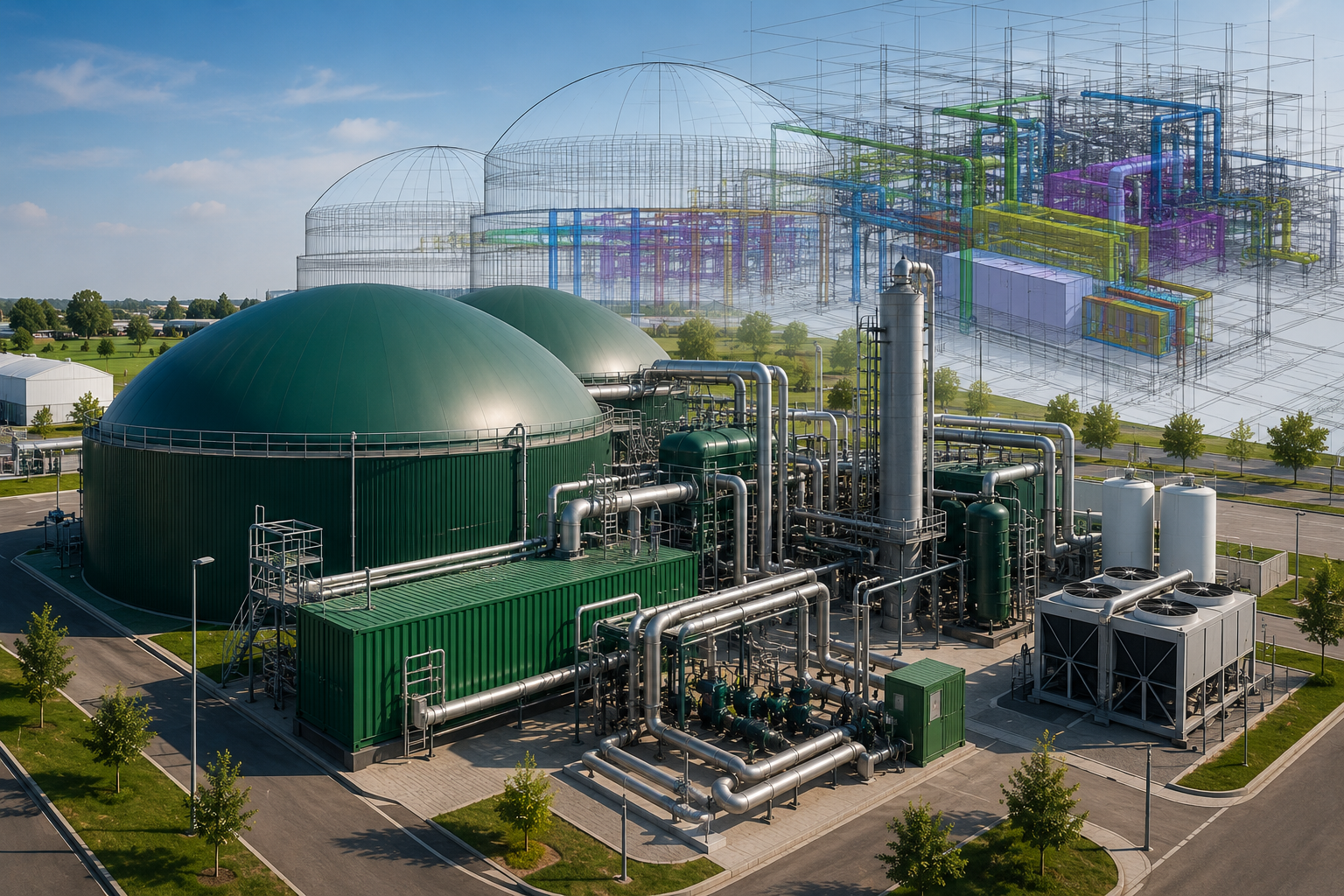
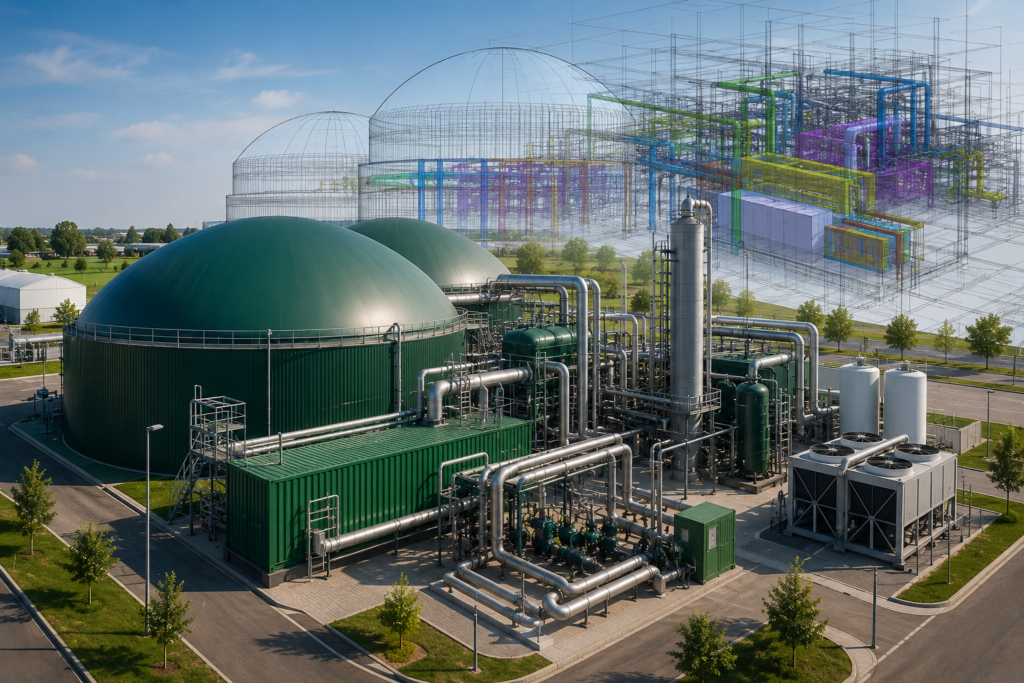
BIM allows different project elements to be brought together in a shared digital environment.
For a biogas facility, this could include the structural model alongside mechanical, electrical, architectural, and other relevant systems.
The benefit is not just having a 3D model.
It is being able to see how different parts of the project interact.
With a coordinated BIM workflow, teams can review:
- Structural elements
- Foundations
- Equipment locations
- Pipe routes
- Utility systems
- Access requirements
Potential clashes can then be identified during design rather than after construction has started.
That can help project teams make better decisions at a stage when changes are generally easier to manage.
From Digital Models to Construction
A BIM model is only useful when it supports the actual project.
For construction teams, the information needs to be clear, coordinated, and practical.
Depending on the project requirements, BIM workflows can support:
- Clash detection
- Coordinated drawings
- Structural details
- Shop drawing support
- Construction documentation
- Quantity information
The aim is simple: give project teams better information before they need it on site.
This can help reduce confusion between disciplines and make complex interfaces easier to understand.
For infrastructure projects, that can make a real difference.
Why Choose Enclave Technology Services?
At Enclave Technology Services, we support the digital engineering and technical coordination side of complex projects.
Our services include BIM, structural engineering, CAD, VDC, detailing, clash detection, and construction documentation.
We do not manufacture anaerobic digesters or provide biogas processing technology.
Instead, our role is to support the engineering and construction workflows around complex infrastructure projects.
We understand that every project has different requirements.
Our focus is on delivering accurate, coordinated, and practical technical information that fits into the wider project workflow.
Because a good digital model should do more than look right.
It should help the project move forward.
Our Service Areas
Enclave Technology Services provides support in areas including:
BIM Services
3D modeling and coordination for complex construction and infrastructure projects.
Structural Engineering
Engineering support for structural systems and project requirements.
CAD Services
Accurate technical drawings and documentation.
Structural Detailing
Detailed project information to support construction and fabrication workflows.
VDC Services
Digital workflows that support planning, coordination, and project delivery.
Clash Detection
Identifying potential conflicts before they become site problems.
Construction Documentation
Clear and coordinated documentation for project teams.
How We Work
Every project starts with understanding what the client actually needs.
1. Understand
We review the project scope, drawings, standards, and deliverables.
2. Plan
We establish the right BIM, CAD, structural, or VDC workflow for the project.
3. Develop
Our team works on the required models, drawings, and technical documentation.
4. Coordinate
We review relevant project information and identify coordination issues where required.
5. Deliver
The final deliverables are prepared according to the agreed project requirements.
Our goal is straightforward: provide technical information that is accurate, coordinated, and useful.
Frequently Asked Questions
What is an anaerobic digester tank?
An anaerobic digester tank is an enclosed structure where biodegradable organic material is broken down without oxygen to produce biogas.
Why is anaerobic digester tank design important?
The tank is a key part of a biogas facility. Its design needs to consider structural requirements, foundations, site conditions, durability, and connections with other systems.
How does BIM help with biogas plant projects?
BIM can bring different disciplines into a shared digital environment, helping teams identify potential clashes and improve coordination before construction.
What is the role of structural engineering in digester tank projects?
Structural engineering helps address the tank’s structural requirements, foundations, loading conditions, durability, and connections with other project elements.
Can BIM be used for industrial infrastructure?
Yes. BIM is particularly useful for complex projects where multiple disciplines and systems need to work together.
Does Enclave Technology Services manufacture biogas plants?
No. Enclave Technology Services provides BIM, structural engineering, CAD, VDC, detailing, and digital construction support. The company does not manufacture biogas equipment or provide biogas processing technology.
Need Engineering and BIM Support?
Complex infrastructure projects need accurate design information and good coordination between disciplines.
At Enclave Technology Services, we support project teams with BIM, structural engineering, CAD, VDC, detailing, clash detection, and construction documentation.
If you need technical support for your next commercial, industrial, or infrastructure project, get in touch with Enclave Technology Services to discuss your requirements. https://www.yenclave.com/contact/
Final Thoughts
An anaerobic digester tank may be one of the most important structures in a biogas facility, but it does not work alone.
The tank, foundations, equipment, utilities, and surrounding infrastructure all need to come together properly.
That is where good engineering and coordination matter.
With BIM, structural engineering, CAD, and digital workflows, project teams can identify issues earlier and work with better information throughout the project.
At Enclave Technology Services, we help support that process with practical digital engineering and technical services.
Because when the details are coordinated early, the entire project can move forward with greater confidence.